A Rainy-Day Walk Through a Fictional Casino Lobby
A rainy-day walk through a fictional casino lobby shows how surfaces, signs and care routines shape a room’s atmosphere without turning clues into verdicts.
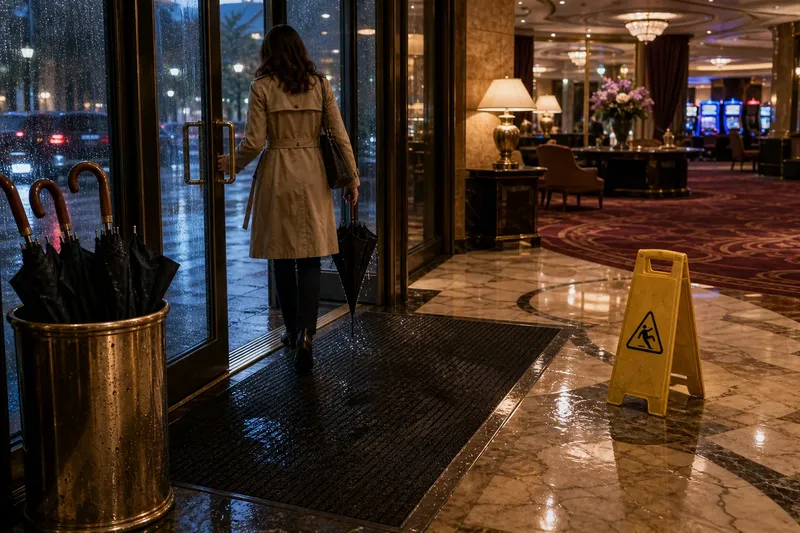
Rain taps against the glass doors of the fictional Marlowe Casino as a visitor shakes water from her umbrella and notices a damp patch on the brass handle. A rainy-day walk through a fictional casino lobby can focus on the materials that weather leaves behind: absorbent matting, polished metal, glass and fabric, and the upkeep each surface calls for.
This is a close look at material care, not a judgement of a venue or its staff. Follow the traces of rain through the room, distinguishing what is visible from what a single moment cannot tell you.
Trace the wet materials
At the entrance, a dark mat sits beside a brass umbrella stand. The mat absorbs water and grit; the stand gives dripping umbrellas a place to rest rather than leaving them against a wall or on a chair.
These materials ask for different kinds of attention. A mat may need replacing or drying when it becomes saturated, while brass can show fingerprints and water marks that call for a suitable cloth and cleaning product. The objects themselves do not reveal how often anyone tends to them, but their present condition can be described precisely.
Notice the difference between an observation and an inference. “There is water pooled at the edge of the mat” is visible; “the entrance is never maintained” goes beyond what one glance can establish.
Compare surface changes
Beyond the mat, the fictional lobby changes from smooth stone to carpet. Stone can reflect light and show footprints; carpet can catch grit and moisture in its fibres, making stains or damp areas less obvious at first glance.
Look at the boundary between the two surfaces. Is the mat wide enough to cover the main path from the doors? Is its edge flat, or curled where a shoe might catch it? Those details describe the immediate state of the floor, rather than the reason it reached that state.
Cleaning methods also depend on material. A damp cloth suitable for sealed stone may not be right for delicate upholstery, and a product meant for brass should not be assumed safe on every finish. In an actual venue, staff should follow the product label and the surface maker’s care guidance.
Notice the care signals
A small caution sign stands near a recently mopped patch in the Marlowe’s imagined lobby. Its placement is a visible signal that the floor may be wet; it is not a complete account of the cleaning process or of what caused the dampness.
Care signals include a bin for used umbrella sleeves, a cloth kept near a service station, or a mat that lies smoothly against the floor. Each can make a routine legible, much as a labelled jar on a kitchen shelf shows where an ingredient belongs without telling you who last tidied the cupboard.
For a careful reading, connect each item to a specific condition and a limited conclusion:
- If water is pooled beyond the mat, note the exposed wet area; then avoid treating the mat alone as evidence that the whole entrance is dry.
- If a mat edge curls upwards, record the raised edge; then describe a possible trip concern rather than guessing how long it has been that way.
- If stone shows fresh footprints, note their location; then avoid inferring how many people have passed through.
- If carpet looks darker in one patch, describe the colour difference; then leave open whether it is damp, stained or simply shaded.
- If a caution sign stands beside a wet floor, note both its position and the visible wetness; then say it marks an area for care, not that all hazards are covered.
- If brass has water marks, identify the marks on that fitting; then avoid assuming that every metal surface in the room has the same condition.
Keep observations useful
Say you are writing a short scene note about the Marlowe’s entrance. You begin with a damp mat, a clear patch of stone beside it and water marks on the umbrella stand; you then describe how the carpet begins beyond the stone. Your resulting note can say that rain is visible on the mat and stand while the nearby stone appears clear, without claiming that the entire lobby is either clean or neglected.
That kind of description is useful because it preserves uncertainty without becoming vague. Name the material, identify the visible condition, and keep any explanation separate unless the scene supplies direct evidence for it.
What do material cues mean?
Can a damp mat show poor upkeep?
Not by itself: it shows that the mat is damp at the moment you see it. Note its condition and any water beyond its edge, but do not use one snapshot to describe an entire maintenance routine.
Why do stone and carpet look different?
Stone often reflects light and makes footprints easy to see, while carpet can hold moisture or conceal a mark within its fibres. Lighting and colour also affect appearance, so describe the visible feature before deciding what caused it.
What should a caution sign tell you?
It indicates that an area may need care, especially if the floor looks wet. Its presence does not establish the source of the water or show that every damp patch has been marked.
How can I describe a surface accurately?
Name the material and the feature you can see, such as “water marks on the brass stand” or “a raised mat edge”. Keep explanations about cause or staff practice separate unless there is direct evidence for them.
Read the room through care
A rainy-day walk through a fictional casino lobby becomes more precise when it follows water across materials rather than assigning a single meaning to the room. The mat, stone, carpet and metal each leave different visible traces, and each calls for a different kind of upkeep.
When you describe such a scene, finish by naming the most immediate practical detail: a clear dry path, a damp patch, a curled edge or a mark on a fitting. That gives the reader something useful to picture while keeping the account fair to what the room actually shows.