Open Shelves or Closed Cabinets for Casino Objects?
Open shelves or closed cabinets for casino objects? Compare access, dust visibility and atmosphere to choose storage that suits each display.
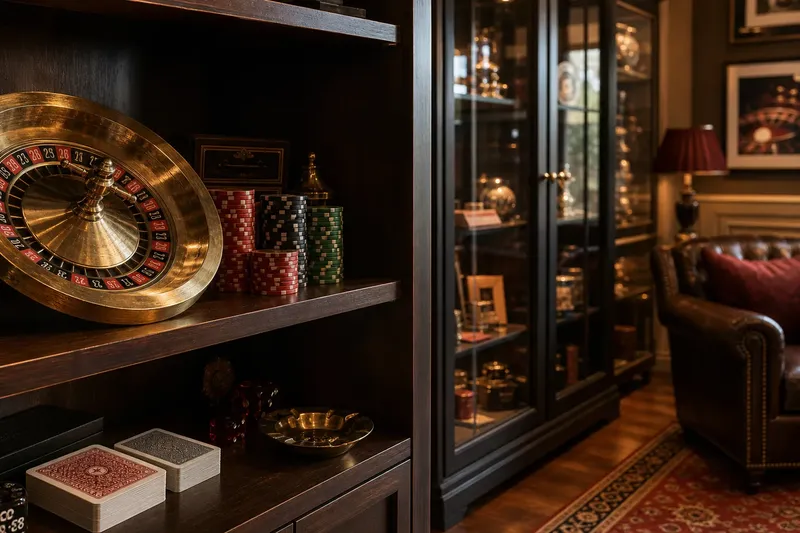
A brass roulette wheel sits on a shelf beside a stack of playing cards, and the afternoon light catches fingerprints on its polished rim. In a casino-inspired room, deciding between open shelves or closed cabinets for casino objects means balancing easy viewing with protection and the mood each choice creates.
Neither arrangement is automatically better. Open storage lets objects take part in the room’s visual rhythm; enclosed storage gives them a clearer boundary and keeps everyday clutter out of sight. Trouble starts when the furniture’s appearance is chosen without considering how often objects are handled, how much dust is visible, or what the display is meant to suggest.
Dust that keeps returning
On an open shelf, dust settles directly on exposed surfaces. It is especially noticeable on dark lacquer, glass, chrome and glossy painted finishes, while carved details can collect it in crevices that are awkward to wipe. A display may look orderly at first, then lose its crispness as the objects and shelf gather a fine film.
That does not mean open shelves are unsuitable. They work well for objects that can be cleaned without fuss and for displays where regular upkeep is part of the routine. A soft microfibre cloth may suit some finishes, but delicate or historic pieces can need different care; follow the maker’s or conservator’s advice rather than applying a household cleaner by default.
Closed cabinets reduce direct exposure, but a door does not make a display maintenance-free. Dust can enter around gaps, settle on shelves during rearrangement, or become conspicuous on the cabinet’s own glass. A cabinet with sliding glass panels may also show smears where people repeatedly open it.
Try matching the storage to the surfaces. Use open shelving for robust, frequently handled pieces that are straightforward to dust, and consider a closed cabinet for objects whose finish makes every speck distracting. If glass doors would make fingerprints the dominant feature, a solid-front cabinet may create a calmer impression, although it hides the contents unless opened.
Access that feels awkward
Open shelves make it easy to pick up a deck of cards, inspect a chip, or change the arrangement. That convenience can become a problem when objects are fragile, easy to knock, or positioned where visitors brush past. A crowded shelf also makes reaching for one item a small exercise in moving the others aside.
Cabinets add a pause between looking and handling. That can suit a collection meant to be observed rather than used, but frequent opening may feel cumbersome, especially if the doors swing into a walkway or the shelves are difficult to reach. The result can be a display that is protected in theory but ignored in practice.
Say you have a decorative roulette marker that guests are welcome to examine and a fragile glass ashtray kept as a visual reference. Placing the marker on an open shelf at a comfortable reach makes its intended use clear; keeping the ashtray behind glass signals that it is for viewing. The observable result is a display with an obvious invitation for one object and a boundary around the other.
Before choosing, ask whether people should handle each object, and how often. Keep regularly used items within easy reach, and avoid placing delicate pieces in a position where a visitor must move other objects to see them. For cabinet doors, consider the room around them as well as the shelf inside: a door that blocks a chair or narrows a passage is likely to be left shut.
Displays that look cluttered
Open shelves expose the gaps between objects as much as the objects themselves. A mix of unrelated colours, heights and shapes can read as storage rather than presentation, particularly when packaging, spare supplies or personal items share the same shelf. Adding more objects often makes the problem stronger rather than solving it.
Closed cabinets can conceal those everyday extras, but glass fronts may still show a crowded arrangement. Reflections can compete with the display, and several layers of objects behind a door can make the contents difficult to read. A cabinet is a frame, not a cure for an unclear arrangement.
Choose a simple visual order before adding more pieces. Group objects by a reason a viewer can recognise, such as game type or material, and leave some visible space around distinctive items. Think of the shelf like a serving tray: a few well-spaced pieces are easier to take in than a jumble pressed to every edge.
If the display must also hold practical supplies, separate the roles. Put the presentational objects in a cabinet or on a dedicated shelf, and keep working stock in a drawer or closed cupboard nearby. This keeps the scene readable without pretending that useful items do not need a home.
Atmosphere that feels wrong
Open shelving tends to feel accessible and informal. It can suggest a lively lounge, a collector’s room, or a place where objects are part of conversation. That impression may suit a themed space, but it can undermine a more restrained, polished setting if every item is equally exposed.
Closed cabinets create a sense of order and distance. Glass-fronted furniture can make objects feel curated, while solid doors keep them out of view until someone chooses to reveal them. The same enclosure can also feel too domestic or museum-like if the room is meant to be relaxed and sociable.
Look at the display from the doorway and from the seats where people actually spend time. If the objects should draw attention, open shelves can place them directly in the room’s sightline. If they should support the setting without dominating it, a cabinet can soften their presence and keep the overall scene quieter.
Lighting changes the impression, too. Reflections on cabinet glass can obscure objects, while an open shelf may cast sharp shadows or expose uneven finishes. Use existing room light as a guide before adding display lighting, and avoid positioning a cabinet where glare repeatedly hides the contents.
Open shelves or closed cabinets?
Which option shows dust more clearly?
Open shelves leave objects exposed, so dust on dark, glossy or detailed surfaces is easy to see. Cabinets limit direct exposure, but fingerprints and dust on glass or shelves can still be visible.
Are cabinets better for fragile objects?
An enclosed cabinet can keep fragile pieces away from casual contact, provided its doors and shelves suit the objects and the cabinet is placed sensibly. For valuable or delicate items, use suitable supports and follow specialist conservation guidance where needed.
What works best for objects people use?
Open shelves usually make frequent handling simpler, particularly for sturdy objects that are easy to return to their place. A cabinet may still suit items used occasionally, but awkward doors or cramped shelves can discourage access.
Can both storage styles work together?
Yes: display robust, regularly handled objects in the open and reserve an enclosure for fragile or visually distracting pieces. A consistent finish or a clear distinction between display and working storage can help the two arrangements feel deliberate rather than mismatched.
When the choice disappoints
If an open shelf looks dusty soon after cleaning, the likely issue is exposure combined with a finish that makes particles prominent. Move the most sensitive-looking pieces into an enclosure, or reserve the shelf for objects that are easy to wipe. Avoid solving the problem by crowding items together, since tightly packed objects are harder to clean around.
If a cabinet feels inaccessible, consider whether the contents belong there or whether the door arrangement is the obstacle. Move frequently handled objects to an open shelf, and keep the cabinet for pieces that benefit from a viewing boundary. If reflections make the objects hard to see, changing the cabinet’s position may help more than adding further display items.
If open storage feels messy, remove objects that do not support the display and give the remaining pieces a clear order. If a cabinet feels stiff or overly formal, place a small group of robust objects outside it rather than opening every door or filling every shelf. The aim is not to make the furniture dictate the room’s mood.
When choosing between open shelves or closed cabinets for casino objects, decide first what each item is for: handling, viewing or quiet atmosphere. Then choose the storage that makes that purpose legible, and leave enough room for the display to stay easy to care for. Where a label, manufacturer’s instructions or local rules govern an object’s care or placement, follow those directions.